skip to main |
skip to sidebar
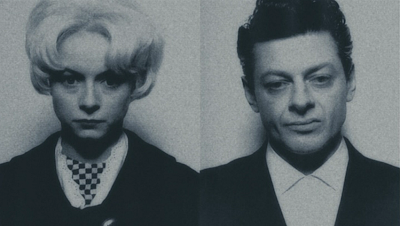 Early in the film the protagonist, the infamous Lord Longford, nervously dodders around a prison meeting room, searching for the prisoner who requested they meet – Myra Hindley. He approaches a woman from behind who shares Myra’s iconic dirty-blonde, big hairdo – But it isn’t Myra, she approaches Lord Longford quietly, and we see she has a generic, long, brown, unkempt hairstyle. This little twist of fakery is representative of everything the film is trying to accomplish with regards to Myra Hindley – To challenge the accepted images and engrained social conclusions, not to separate and elevate her to a demonic creature, but to look at her for what she is, even after all the brutal slayings: A human being. As the film progresses Lord Longford foolishly thinks that he has a significant connection with, a connection founded on a perceived shared deep interest in the catholic faith, resulting in Longford believing that Myra is somehow redeemed, and even more ridiculously believing that his own actions are in service to God. As he puts it, “If you were forgiven by God, who are we to condemn you.” The issues covered and the questions raised while relating specifically to Myra Hindley and the uniqueness of her case, are still extremely relevant in regards to the reaction to the aftermath of terror and in particular if forgiveness and redemption is possible – or should be allowed to be possible – in those who have shown themselves to be empty of the normal behavioural faculties that make us all human. Many questions are posed, is it evil to ignore those who seek help? Is it to be truly good necessary to ignore past evils? Is a good act good regardless of motive? – However you look at it the line between what determines the universal constants of “good” and “evil” is blurred, crossed and erased altogether throughout the film, resulting with Longford and Myra carrying the true-to-life shades of grey, and the ambiguity and futility inherent in attempting to achieve spiritual wholeness and acceptance in oneself, which they uniquely try to seek through each other to debatable degrees of failure.Myra has a sort of predatorily chameleonic personality, even when she’s acting like the wide-eyed good Christian girl it’s clear that she’s working her thrall on the Lord – Something chillingly ironically the judge in the real case said Myra was under with Ian Brady. She’s rarely cruel, most times seeming quite pleasant on the surface. Her dialogue and the delivery is vaguely sensual, in particular her retelling of her confessional is tinged with a kind of purity and virginity Lord Longford can’t help but buy into. Samantha Morton, who was so ethereal and vulnerable in Minority Report, is so gaunt and hopeless, like a solid brick wall. She shows a great talent for playing the emotion close to her chest, but her character is still fascinating and captivating – Her interpretation of the woman has levels of realistic humanity few would give to such an apparently simplistic insane woman. Each of the three main cast go through a radical transformation for their parts. Jim Broadbent’s physicality is changed entirely, by use of prosthetics, altering his voice and his adoption of Longford’s mannerisms. There’s always a looming shadow of tragedy cast over Lord Longford, behind the bumbling and upper-class joviality lays a troubled individual, and Broadbent knows exactly how to do the character justice by both recreating the famous persona and revealing the man’s desperate, desolate side. Andy Serkis, famous for his other psychopath, Gollum, is absolutely terrifying. Controversially he went to visit the real Ian Brady to better emulate the man – And it shows. Here is a man who is fully aware of his own insanity, even proud of it. He exerts a confidence over all and is simply overpowering to watch. As Gollum, Serkis mastered a character many would call ‘inhuman’, here he does the same but in a very different way, proving, as if there were any doubt, that he is capable of great range in performance.
 While the script is necessarily ambiguous, the compositions and drained colours are telling of the characters’ senses and impulses. Myra is shot like a withered, dead flower decaying in her chair, never given colour or real light to bloom, always engulfed by the walls and barriers. When she does briefly go outside it’s an extra-sensory experience for both her and us, I found myself gasping as children walked by serenely unaware of who was in their midst. Myra’s eyes dart around in extremely extreme close up. She’s just as intensely anxious as we are, the full effect of society’s outcast of her is felt: strangling, displacing, it’s bizarre to see so honestly the effects of imprisonment, like an after-effect, a cruel scar she can never be rid of. There’s a very British aesthetic to the film, with the sense of emotion lingering underneath everything, bottled up pain dying to surface, claustrophobia in every room. This mood can be seen in all of the Myra and Longford scenes, further suggesting the two of them never really know each other, each of them withholding thoughts and emotions from the other to suit their own requirements. For a film mostly taking place in prison it’s shocking how visually varied and engaging it is, the blank surroundings and luminous unnatural light sources are put to excellent use, having strange presence in the background around the characters, they’re sterile and unwelcoming and feel like they will swallow the characters and we the viewer whole.
Thinking over the motives of both Myra and Lord Longford in their relationship is something the film encourages from the start, intelligently straying away from easy answers (that in such widely documented criminally cases are rare to find but the public jumps upon) Society misunderstood both of them, more so with Longford, and as the film progresses it becomes clear that they never fully understood each other either, which seems to be at least a partial conscious decision. Their relationship is compelling, and realistically lacks sentimental development – There’s no moment of realisation (at least not one vocalised outright), an even-level togetherness or anything resembling a shared sense of happiness. Even with those deficits it is clear that the relationship was important to each of them on some level. While Myra is someone I would call ‘forever unknowable’, even in cinematic form (the greatest praise I can give to the films treatment of Myra is that we don’t know her at the end of it all), there is some kind of urge of hers that Longford shares to stay loyal, and hold some of Longford’s trust – Whether she wants it for her own gain, and at times she clearly does, she wants it none the less – And something so strong cannot be simply tied down to basic manipulation.The start of Longford’s involvement with Myra comes from her desire to see Ian Brady, something he discourages claiming it would affect her parole. Her shock at this suggestion is the turning point for both of them – In him, she sees someone with an impulse to help others, which superficially she can use to her advantage but perhaps also longs for – In her, he sees a damaged girl needing to be healed, and in turn from this he gets a kind of false spiritual pleasure, something he fails to see the perversity in. This calls into question whether his act of sporting a woman so unfairly maligned should be considered respectful and taken seriously due to the complex motivations behind it, when looked at his involvement as a whole was he seeking some kind of self-aggrandizing redemption through Myra, or genuinely caring for her well being? As we see later in the film Longford briefly moves onto attempting to ban pornography and even offering Ian Brady his hand in aiding his hunger strike, which in turn with the odd atmosphere around the Myra/Longford scenes, I see as effectively confirming the invalidity of his ‘social missions’, with them instead serving as self indulgent, faux-emotional flights of fancy to aid his own insecure spiritual well being – He claims a personal spiritual development in himself through his prison visits, even being thankful of Myra, but when faced directly with the massive true evil of Myra Hindley, in the film’s most breathtaking moment during their final meeting*, it looks like the enormity of his mistake has just hit him. It’s amazing that even during this brutal, soul-bruising moment he remains loyal to her and her to him. I feel that what makes this almost unbelievable, impossible relationship so touching is its honesty and the unspoken compassion that they clearly share for each other. At the end of it all they are both fully aware of the other’s manipulation, Longford of Myra’s trickery and Myra of Longford’s self gratification through her. Despite the alarming number of blockades between them, literal, social, and ones they erected themselves, there’s a solace to be found in someone who shares the same powerful longing for meaning. They both share a personal emptiness, but together it is filled. *Quote: “But If you had been there, on the moors, in the moonlight, when we did the first one, you’d know, that evil can be a spiritual experience too.”
 Mishima: A Life in Four Chapters is an emotional mosaic of a film, there is as the title suggests a clear structure of four chapters, but inside these are three separate - but cohesively linked through what they observe in the character of Mishima - modes of storytelling. They can be broken down as past (From childhood to the last day of his life), present (a real-time following of Mishima, ending with his famous act of public seppuku) and imagination (Three of his novels brought to life). It’s rare that a film is so interconnected through style, substance and structure, the organised wholeness reflecting the subconscious life-long mission of perfection that Mishima embarks upon, ending in (when observed as a whole) what seems like a predestined fusion of artistic expression, destruction and a longing to change the world. There is a rolling development to the character, glimpses of ideas and emotions in his past are exposed and consciously studied in his novels, and are fully realised in his final act of self-crafted spiritual beautification, an act which can be viewed as a culmination of the depths probed in the first three chapters of the film; art, beauty and action. The final chapter, The Harmony of the Pen and the Sword, is the most honest and brutally real, no novel to hide his extreme personality and ideals, baring his soul forcefully through protest and finally destroying himself at his highest point of honour and power.The film is incredibly arresting, the style different for each mode, each with its own visual language and manner of exploring Mishima. His past, in harsh black and white, is shown in an un-probing way, in a near historical-recollection fashion, and we simply follow his life. At first the novel sequences are quite jarring, they are so vibrant, raw and colourful, full of telling compositions and beautifully crafted, hyper-stylised sets. They are all rooted in total blackness, like they’ve just sprung up in Mishima’s mind (occasionally the novel sequences are preceded by a scene of Mishima writing), the absorbing artificiality of it all is at odds with the shut-out realistic style of his past. It’s a bold move to blend such opposite visual storytelling techniques, but the events of his past amalgamate with the beauty and emotional forwardness of the novel sections to fully conjure up Mishima. Neither would work on its own, but together they work as one and fill in the gaps that they other left out, the lack of expression in his past is filled with the constant rampage of passion found in the novel sequences, and the lack of conjunction of each novel sequence is an irrelevance as they compose of crucial elements we are now able to see reflected in Mishima’s past life, and most importantly his final day. Starting with Mishima getting ready, there’s a roaming kineticism to the camera. The focus is stuck on Mishima, gliding over his immaculate army uniform and watching him button up in close up. It’s a very finalised way of shooting, like everything is being seen for the last time so is given a grand send-off. He is followed documentary style, hand-held camera and tracking shots structured in real-time. This almost displaces Mishima in the external world, in some ways casting him in a different light, making him seem like a determined mad man in a world full of coasters. Philip Glass’ score is outstanding, punctuating Mishima’s fixed path with absorbing rushes of sound. Like Mishima, the score has an evocative presence, a complicated array of short stabs of strings and bells, repeated over and over again but never faulting in aiding the visual climate.The film is an interpretation of Mishima, but is surprisingly without conclusion. This is not a flaw, Schrader bravely chooses to avoid judgment or criticism, putting Mishima in an as-close-to objective light as possible. Through the sociological fundamentals of sexuality, political action, art, and the body, Mishima attempted to perfect himself. He achieved great literary success, he body-built himself into a towering statuesque figure, he formed a private army of dedicated fellow traditionalists. What conclusions can be drawn from these achievements? Many, but I believe that Mishima is a man who never lost his childlike yearning to change the world. He carved his own destiny out of his body and his work, set his mind on a clear path early on and obstinately followed it to the glorious end. Whether or not one agrees with his life’s work, I cannot help but admire his yearning for fullness. Someone who is so rigid and immovably confident in everything he does may seem unlikable, and he most certainly isn’t a likable character in the strictest sense. He is, simply put, a self-formed piece of art. A piece of art that I cannot help but be fascinated by. Mishima: A Life in Four Chapters does the impossible and shows a life eternally connected to art, a life defined and destroyed through art, and fittingly it is a colossally profound and ambiguous work, a ravishing exploration of a man who melded integral desires of creation and impact together to shape something unique and special in himself, in death he was his own vision of perfection, even when the world was not.
 As James Gordon said at the end of Batman Begins, as Batman turned over the Joker playing card found at a murder scene, setting the wheels in motion for him to confront his greatest enemy, “He’s got a taste for the theatrical, like you” And that comparative outlook, the extreme differences and similarities in their oath-like rules of action and image gives The Dark Knight one of its numerous points of intrigue and depth, the points of which set in a better realm than other action films. In fact, the term “action” would be low-down on my list of how I’d label The Dark Knight. Character-drama, psychological thriller and a twisted crime saga would come before it, but the film is so extraordinary because it weaves these together, creating a beating black-hearted tone of enthralling, realistic confrontation and tragedy – a purely awe inspiring piece of cinema, exhilarating and fascinating in equal measure.Gotham City is subjected to a mastermind of mayhem, destroying its civilians as quick as its values, his reign and Gotham’s crime challenged by an ambiguous hidden protector and a fiercely morally dedicated lawyer, Harvey Dent. Though Batman is The Dark Knight, it’s this trio of independent forces together that form the core of the film’s intellectual and emotional weight, the three are connected by crime, between them a cracked mirror of opposite yet parallel self-guiding philosophies, morals, and social visions. The three all test and are tested by the criminal flow of Gotham, their characters shattered and defined by the world around them, Batman and Dent have limits, but their mutual enemy is, in his own words, an unstoppable force. The Joker comes pre-damaged, we do hear of his past but he provides two conflicting stories, an important move underlining his present evolving threat, there is no way inside him, no way to evoke empathy or sympathy within him, and in a wise move we too aren’t given the opportunity to do the same – He’s the frontman of the apocalypse, mental scars and sicknesses burn in him, he loves every infliction of pain he gives, but most of all relishing at the evil in others, as if he takes his own insanity as a given. Like Batman, he’s introverted in his actions, using his personal damage to manipulate and destroy others, extracting from himself an evil so engrained, unleashing it on everyone he meets, until they either submit or perish. All the praise I have for The Joker goes to Heath Ledger. His lines are gleefully dark and superbly written, but they wouldn’t be half as much without his delivery. I must say that I didn’t feel sad watching his performance, I saw an actor so embodied in the role, so passionate and dedicated to the character I found it impossible to separate them, there was only The Joker. His performance reminded me of Daniel Day Lewis’ of There Will Be Blood, like Plainview The Joker operates on a different wavelength than anyone else on the screen, it’s like there is frame within the frame around him, I couldn’t help but look at a scene from the Joker’s eye and find myself celebrating his orchestrations of chaos, and laughing at some of his twisted jokes (the now infamous pencil trick comes to mind) and like Plainview the actor knew when to bring out the true monster, momentarily shock and disturb more so than usual, showing even more madness and rage than thought humanly possible. His lust (the way Ledger plays many scenes makes it appear that the Joker is salivating at all the terror he’s causing) for atrocity and anarchy is captivating, an unrelenting need for sin is rarely performed with such versatility and commitment.Cities are so often alienating when shot from such heights and angles, but here the city is absorbing, the photography drew me in to Gotham, through its shadowy streets and around its economical monoliths. The incredible wide shots and slow-moving high-angle tracks give the expansive urban landscape an all-encompassing epic sensibility, and watching Batman sail over it he truly does look like Gotham’s only saviour. There are several stylistic touches that bring out the emotions from the consistently well-textured screenplay. When The Joker crashes a party, the camera sticks to him, going in and out of focus, jittering around to follow his movements, it’s a perfect way of expressing his unpredictability and concentrated form of lunacy. The mood is very well represented from a visual point (the scenes in Batman’s empty warehouse make excellent use of the alternating bright lights and total blackness, and the long, empty spaces), and the action sequences are staged and choreographed with great precision and skill. There are more than the previous Batman film, but each one tries something different than the one preceding it, so they all feel thrilling and invigorating in different ways. Christopher Nolan’s direction is outstanding, whether it’s an effects laden action scene or a conversation of emotional significance, he brings a genuine flair for depth and originality. He wants the viewer to become immersed in the all scenes, not just the expensive ones, and I personally was engrossed and entertained by his work in this film.Corruption in all its forms is an important element, shown through nearly all the characters as they’re tested by Gotham’s bent police force, The Joker’s special brand of disaster scenarios, and his taste for bringing out corruption in others. Harvey Dent is the White Knight to Batman’s Dark, and there are numerous ties between them. The combination of a humanistic, equal type of justice, which Dent enforces and Batman lacks, and a righteous self-elevation to overpower criminals that Batman utilizes and Dent turns to in a situation of tragedy, flits between them at varying levels as they both try and internally balance the two to defeat the worst of Gotham. Batman is almost lawless, with not killing being his only rule. The Joker is the Batman’s first threat to compromise that rule, it’s more the human side of him fighting through the Batman persona driven to consider murder, the one we saw nearly attempt murder before the creation of Batman in the first film, if it were possible for the dark knight himself to get even darker, it’s done through his wickedly black chemistry with the Joker.The supporting cast all do excellent work, notably Gary Oldman and Michael Caine. Batman’s relationship with these two takes a backseat to all the action and plot, but all the scenes they share with him do entertain and give a sense of variety next to the frequent Dent and Joker scenes. Like the three main players, Oldman’s character is tested by The Joker and perhaps has the most difficult job of any of the characters, his allegiance with Batman threatens his own personal safety but is required to aid Gotham, as well Batman infringing upon his state-enforced limits as a police officer. Alfred is often very funny, and occasionally wise, his story about how in his younger days he caught a gem thief by burning a forest to the ground is a clear influence adding to Batman’s clash between compromising his values and maintaining his morality in the face of the Joker. Maggie Gylenhaal is an improvement on Katie Holmes, pulling off well Rachel Dawes’ different kind of dilemma. Torn in love between the dark and white knight, she looks visibly weary at having to choose, and even though her character isn’t given much depth, she is convincing and works well with the other cast. The Dark Knight is alarming in how much it accomplishes. It cares as much for pure thrilling violent spectacle than it does for forming an unpredictable, haunting atmosphere. Watching it it feels like there isn’t anything that was neglected or favoured. It’s a supremely balanced achievement, a truly artistic endeavour that delivers everything that one could possibly want from a film. Christopher Nolan set a new precedent with Batman Begins, a humanly-minded portrait of a creation of a symbol. The Dark Knight is deeper, darker, more dangerous, more ambitious, more character-driven and more downright electrifying film than I thought possible for a film about a man in a costume fighting crime.
 Isao Takahata is well known for his WW2 story, Grave of the Fireflies. That film is deservedly highly acclaimed for its tender and tragic vision of war-time orphans, offering a story that’s at odds with the usual conventions of anime, straying far away from fantasy and heavy confrontations and concentrating on the realistic and true to life. Only Yesterday shares that films humanistic values but focuses more on a personal dilemma, more detached from the outside world and self-reflexive. Grave of the Fireflies worked as a window into the past, a vision of a global tragic event scaled down, Only Yesterday is more relatable and profound because of its individualistic subdued style, character development and in turn offering a more concise study of human nature that’s debatably more fundamental than coping with tragedy, in this case focusing on the effects and even the act itself of recalling memories, the difficulty in overcoming one’s own mistakes, and of the complexity of reflection and change. Taeko, an unmarried 27 year old, born and raised in Tokyo decides to go and visit her sister’s in-laws in the countryside, while on the train she starts to remember events from her life when she was a young girl of about 11. We witness her past and see her find out and worry about puberty, struggle with maths problems and become more interested in boys. There isn’t an exact structure to the recall of events, they function as real memories, avoiding the neatness of having each one fit firmly into the story and serve to show everyday moments of development of the younger Taeko, despite an apparent lack of magnitude each one has had a cumulative emotional effect on her present in her as an adult, and we can see that Taeko enjoys dipping into her past as much as we do.Taeko isn’t a large character, in both childhood and adulthood, but through the film we do get to know her immensely and I found myself calm in her company and fascinated with her memories and the slight jolts they give her, watching them build up, her character changing and in many ways becoming the person that she was prevented being as a child. Atmospherically Only Yesterday reminded me of Ozu’s best, relaxed and timid but capable of surprising me and forcing a powerful reaction out of little narrative, such as Taeko recalling her time in a school play and the passion she put into the single line that was attributed her. Being a Studio Ghibli film the animation is naturally fluid and stunning to admire, there are little touches of brilliance in the animation that aid the characters and story structure. During the memory sequences the colour is noticeably less prominent in the background, and the edges of the frame have a faded hue to them, accentuating the act of recollection and drawing attention to the people and less on the surroundings. I wasn’t surprised to read that the facial expressions were, in an unusual move, animated after the dialogue had been recorded, giving the people more physical detail and presence, making them seem more human in a medium that makes doing so a task in itself.There are several moments in Only Yesterday that aren’t related to the narrative but still revelatory of Taeko’s inner meditations and conclusions. One in particular is of her and the others farming in the fields , they all stop and watch in awe as the sun peeks over a mountain and pours light across the field. This and the others like it serve more as moments of life than of character, showing snippets of emotions and reactions universally present in our behaviour, but still remaining connected to Taeko and her gradual development. Another of these low-key moments is Taeko and a man she meets, Toshio, engaging in small-talk and slowly getting at ease with each other. In scenes like these we see that the film isn’t intending to make grand, sweeping statements about behaviour and thought, it’s more concerned with those which could be labelled as ordinary, the special qualities of which arise not from a extreme demonstrations of emotion, but fundamental truths exposed in Taeko’s past and present that make watching the film and going on her journey an empathetically involving one, showing us that these (often ignored in cinema) day-to-day trials and experiences can be just as important as the grander, life-changing ones found in Grave of the Fireflies. Only Yesterday stands as one of animations most mature works of genius, joining the likes of Princess Mononoke and Nausicaa as one of Studio Ghibli’s best pieces of pure cinema.
 There’s only so much that can be done onscreen involving a gun. There’s using them to hit people, shooting them out of opponents’ hands, and of course a barrage of bullets delivered by a variety of weapons. Hard Boiled accomplishes all of these options and then some. The early action scenes are exhilarating, bodies fly all over the place like shrapnel and blood explodes out of people in slow-motion. Centred around 4 action scenes, the other scenes don’t offer much else to engage with, just moving the narrative to different locations and bringing the characters along to reveal new motives for making fresh corpses.Outside of the set-pieces we follow the underworld of the Triads and the police procedure, though there’s no realism to either group. It’s all rather silly and cheesy, with the obvious metallic-whooshing sound effects to attempt to heighten tension and suspense, it all rather falls flat. The music is excruciatingly bad, and accompanied by poor editing, specifically an overabundance of fading during mid-scene, make some scenes unbearable to watch from a technical standpoint.Chow Yun Fat made his name in three “heroic bloodshed” (the name of the sub-genre of stylised-action Hong-Kong films) films directed by John Woo. One of the facets of this sub-genre is honour and duty, inspiring the “heroic” part of the term. There is a kind of twisted morality to the film, in the first lengthy opening shootout at least 50 people are taken out with one every couple of seconds, but the lead cop only shows sadness and overwrought regret when his partner is shot down – there’s no thought to the masses of other bodies littering the now-destroyed restaurant. The characterisations similarly don’t make sense, there’s an old gang leader who’s presented more like a doddering old grandpa, there’s no logic or reason to the writing. I found myself wincing at the image of the previously shown tough female cop going all of a flutter around babies at the nursery in the hospital, where the final showdown takes place. The script is sloppy and clichéd, in an early scene a killer takes out a man by shooting him in the head, a cop says out of nowhere “His shooting style is unique “ in a lazy attempt to build up the character and add mystery, it doesn’t work and just comes across as false – there’s nothing unique about shooting someone in the head.Hard Boiled entertains when it abandons its attempts at truth and emotion and just goes all-out with the violence. But about two thirds into the film I was getting sick of it, there was nothing left to do with a gun. All the action scenes take place in irregular places, adding props and structures to blow up and to utilize in the fight, the most impressive being the midway warehouse scene. The body count is recorded as being 307, and the final action sequence is at least 25 minutes long (set in a hospital it mainly consisted of running through corridors, shooting patients – which didn’t aid the already long-gone ethics) – blood and guts are fine, but when there was this much of it the film got tedious fast.
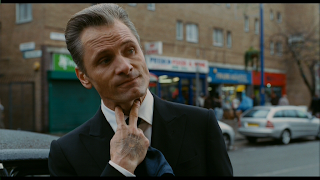 By the first 15 minutes of David Cronenberg’s Eastern Promises, there’s already been a fair-share of bloodshed. A Russian mobster has his throat slit in a barber’s chair, a young prostitute haemorrhages during childbirth, and the baby is covered in the blood of her mother, now dead leaving only the baby and a diary behind. With all this potential and diversity in story shown in such a short time, it is disappointing that apart from the extreme scenes of violence, Eastern Promises fails to provoke any sort of reaction. Eastern Promises features the real-life Vory V Zakone, an underground Russian gang, helmed by Semyon, a softly spoken and ruthless old mobster played by Armin Mueller Stahl. His son, Kirill, played by Vincent Kassel and their driver Nikolai, played by Viggo Mortensen (who featured in Cronenberg’s stylistically messy A History of Violence) all revolve around a plot to stop Anna, a midwife who finds the diary, incriminating the gang members in several sex-trafficking related crimes. The problem with all this is that the intention is to explore the way-of-life of these gangsters from the outside, but this doesn’t happen because the gang is never fully mapped out. They never commit any crimes. They seem to have only one building at their disposal. There only seems to be about 5 members. I never felt the full force of their power like I did for the wise-guys in Goodfellas. The violence does show the extreme behaviour that naturally exudes from living this kind of life, but even then they only seem to go after each other. Even the mysterious higher-up leaders don’t provide more detail, simply showing up from hidden sources of power and strength that we aren’t privy to – I was disappointed at the end at how little we learnt about how the Russian mob operated, they seemed more like a failing business than a controlling, intimidating crime-squad. Cronenberg also fails to give London the same kind of black, pulsing heart of the L.A in Heat, or the New York of Goodfellas – Further making the film feel more artificial, like it isn’t taking place in anywhere in reality.Viggo Mortensen’s is a rare case of a deserved Oscar nomination for his embodiment of the role. The accent is pitch-perfect, the mannerisms and style all collecting to create his character. His personality is never really exposed, never beyond much more than downplayed intelligence and natural charm. He always seems like both an outsider and an adamant insider, his moral compass swinging around throughout the film and never landing squarely on a single spot. Even when the film itself is mediocre and plodding, he is always fascinating to watch, never knowing when his character may evolve into something we haven’t yet been shown.The ending of Eastern Promises somewhat lends itself to a possible sequel – Which I doubt will ever take place, though part of me wishes would. I felt like I’d only been shown a glimpse, then torn away from the deepest, darkest corners of the Russian crime-world – The characters and their dynamics are interesting to watch, but even that and Viggo Mortensen’s commanding screen presence didn’t fully make up for the lack of depth or detail in the films narrative and focus point. For a film that I was never bored to watch I was surprised at how little I got out of it.
 For a Disney Pixar film what surprised me most about WALL-E is just how dark it is. Yes, there’s the fast-paced motion-based comedy and quick visual jokes, but there’s also a different kind of tone in regard to the human characters. There’s none of the comfortable security present in so many children’s films. In fact one could even argue if WALL-E is primarily a children’s film, there’s none of the colourful backdrop (at least in the earth segments) of Cars and Finding Nemo, no array of funny sub characters chipping in quick–witted comments, and an image of the world that’s shockingly grim and cynical. This is all very beneficial to WALL-E, its Pixar’s most ambitious film to date; they have raised the bar yet again in what they will focus on and how they tell their stories, if anything it’s more like an art film than a multiplex blockbuster. Yet it retains the core elements of all the best Pixar films, a daring world-of-it’s-own universe, strikingly fluid and astounding animation and genuine emotional development and depth in its characters.WALL-E himself is one of Pixar’s most lovable, engaging and well-drawn (literally and in terms of personality) characters. His little mannerisms and mechanical features are so thoroughly articulated and designed, his clunky tyre tracks and jittery head giving him all the dimensions and expressions of a person. The only human facial feature that WALL-E retains are his prominent eyes- no mouth to smile or frown with, and he still manages to be as emotive as any of Pixar’s weird spins on real-world objects or creatures. Ben Burtt, the man responsible for recording and orchestrating the sounds of WALL-E and other robots deserves credit for the life he has breathed into these characters just through sound. WALL-E’s curious whirring noises and beeping squawks help to give the little robot presence and a heartfelt endearing quality.WALL-E is the one and only individual left in a world full of robots controlling humans and turning them into lazier, fleshy robots. The society of the future is basically nonexistent, there’s no socialising to speak of. Screens are projected in front of everyone’s faces 24/7, they play virtual golf and in classic sci-fi fashion, eat entire meals in liquid form. It’s a very dark image, and while done to poke fun at the stupidity of the humans, it’s slightly depressing. Advertising screens are never out of frame when we board the new home for earthlings, the space ship Axiom. There’s a gloomy paradox in WALL-E present in many Sci-Fi films, that once humans have reached and explored the depths of the universe, they’re unfazed and even ignorant of the limitless freedom of it all. There’s a lovely montage of WALL-E marvelling at galaxies and stars, reaching out and being in awe of it all – on the space ship, the humans simply sit in their hover-chairs and have even begun to forget where they are.With all these political views underpinning the entire film, at heart WALL-E is a classic love story. The opening section of WALL-E shows us just how alone the little robot is – the impressive photo-realistic animation of earth, the towering structures of garbage and dusty wastelands surrounding the city give the film a very dystopian and gloomy atmosphere. The quick zooms and pans, wide tracking shots of WALL-E bobbing along doing his daily chore, and the detailed tour of his job and trinket-filled home paint a picture of a very isolated little robot, who over 700 years has evolved within himself and extracted all of the best human qualities through our devices, games and even movies. We see WALL-E watching the 1969 musical Hello, Dolly!, focusing on a song involving two partners holding hands, an important gesture that WALL-E in his advanced state instantly recognises as a sign of love. When EVE, a robot sent to look for vegetation, shows up its delightful and exciting to watch WALL-E do his best to keep up (literally) and connect with EVE. The way their relationship evolves is excellently handled and very involving, they barely speak a word to each other yet the relationship is crafted in a believable, gradual way as they learn how they learn to relate to each other. WALL-E is so successful because of how challenging it is, the dialogue-less opening segment and its political message, simultaneously mixed with a beautiful love story and typically imaginative Pixar twist on the world. I’ve noticed that in all of Pixar films there are several clearly defined processes at work – In Toy Story, the rigorous regime of surveying Andy’s birthday presents, in Monsters Inc, the structure and organisation of the monsters’ work – In WALL-E, what makes it so unique in Pixar’s canon is that it its processes directly relate to our own. While put to the extreme, the vision of the future, with its blatant commercialist control exerted so subtly so the humans don’t even know its happening – Is tragically all too reminiscent of the corporations of today. The environmental message is just as relevant and important. Hopefully, as the message is so well handled and masterfully blended with a terrific story it will manage to influence the people of today – and tomorrow, and of many generations to come.


